
Key Takeaways
- Estate planning for collectibles isn’t just paperwork — without instructions, heirs often can’t tell a valuable piece from a box of leftovers.
- Write a “collector’s guide” that explains what you own, why it matters, and roughly what it’s worth.
- Naming specific beneficiaries for specific items avoids disputes and ensures pieces go to people who’ll actually value them.
- A professional appraisal gives your heirs (and your estate plan) a real number to work with — not a guess.
- If your family isn’t interested, selling the collection yourself while you’re alive is often the better outcome for everyone.
The Case for Estate Planning for Collectibles
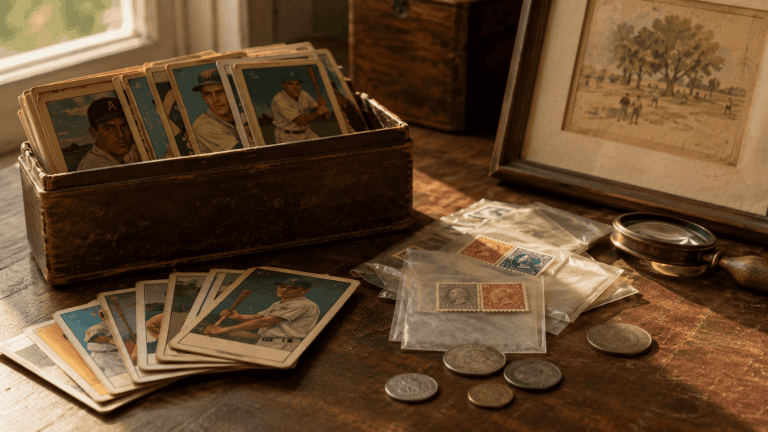
Everybody collected something as a kid. What was yours — baseball cards, “rare” stamps, “valuable” coins? Maybe in your early 30s you bought a piece of ugly “investment” art that’s been collecting dust in the spare bedroom ever since. You’re still holding out hope it’ll be worth something someday — and maybe it will. But here’s the cold fact: when it comes to estate planning for collectibles, the things you love and the things your family loves can be two very different lists.
The Collector’s Dream (and the Heir’s Dread)
As a collector, you’ve felt the thrill of finding that last piece to complete a set. You know the story behind every item, and you’ve told those stories more times than your kids and grandkids would probably admit to your face. What you see as a treasure, they see as a pile of old stuff taking up space in the basement. Don’t take it personally — what’s your thing isn’t necessarily their thing.
That’s one of the quiet disappointments of collecting. What looks like a treasure to you might look like trash to your heirs. There’s a good chance they can’t tell the difference between a mint-condition 1952 Mickey Mantle card and a random shoebox of 1990s Topps. The item that makes your heart race might, at best, get them to place one call to an appraiser before it heads to a resale app.
So What’s the Fate of Your Collection in Estate Planning?
When it comes to estate planning for collectibles, this is where Kabb Law comes in. If you don’t want your collection sold to the first dealer who shows interest—or worse, dropped off at Goodwill—you need to spell out exactly what you want done with it.
Collectibles are only valuable if the person holding them knows what they’re looking at and is willing to put in the work to maintain or sell them right.
If it matters to you that your stamp or coin collection ends up with someone who’ll actually love it, plan ahead.
That means:
1. Leave Explicit Instructions
Write a “collector’s guide” for your heirs. Spell out what you have, why it matters to you, and roughly what it’s worth. A named last will and testament can point to this guide so it’s a real part of your estate plan, not a note that gets lost in a drawer.
2. Name Specific Beneficiaries
If your brother’s granddaughter is genuinely into stamps, or your best friend from high school is crazy about art, leave those items to them directly. Naming specific people for specific pieces can head off disputes and put your things in the hands of people who will appreciate them.
3. Get a Professional Appraisal
Serious collections deserve expert eyes. A qualified appraiser — look for one accredited through the American Society of Appraisers — can help your heirs understand what’s actually valuable versus what’s simply sentimental. That number also matters for estate tax purposes; the IRS’s guidance on valuing property for estate and gift tax is worth a look if your collection is sizable.
Don’t Be Offended If Your Family Doesn’t Want It
Keep in mind: your family might not want your collection, and that’s not a reflection on you. Everybody has their own passions. Often the best move is to sell the collection while you’re still around to see someone’s face light up when they see what you’ve got. That way you know it’s landing with someone who’ll genuinely love it — instead of leaving that outcome to chance.
The Bottom Line: Plan Ahead for Your Collectibles
Estate planning isn’t just bank accounts and real estate. It’s the “out of the ordinary” stuff too — the collections that made you who you are. If you want your prized items to end up in a good home, don’t leave it to chance. Talk to your family. Write everything down. And maybe take Rachel Kabb Effron’s best advice: let go a little.
Because as much as we’d all love our heirs to cherish what we’ve collected over the years, sometimes the real value was never in the memorabilia — it was in the memories. Don’t lose sleep over it. Instead, talk to Rachel Kabb Effron at Kabb Law: 216-991-5222.
FAQ: Estate Planning for Collectibles
What happens to my collectibles if I don’t include them in my estate plan?
Without instructions, collectibles usually get treated as general personal property. Heirs who don’t understand the collection often sell it quickly and cheaply, donate it, or discard it — because they have no way to tell what’s valuable and what isn’t.
Should I name a specific person to inherit my collection?
If you know someone who shares your passion for the collection, yes — naming them directly in your will avoids disputes among heirs and increases the odds the collection stays intact and cared for.
Do I need an appraisal for my collection before I die?
For any collection with real value, yes. An appraisal gives your heirs a documented value to work from and can matter for estate tax purposes. It also helps prevent the collection from being sold far below its worth.
What if my family doesn’t want my collection at all?
That’s common, and it’s not personal. Many collectors choose to sell their collection during their lifetime so they can see it go to someone who genuinely wants it, rather than leaving that decision to heirs who may not know its value.
